
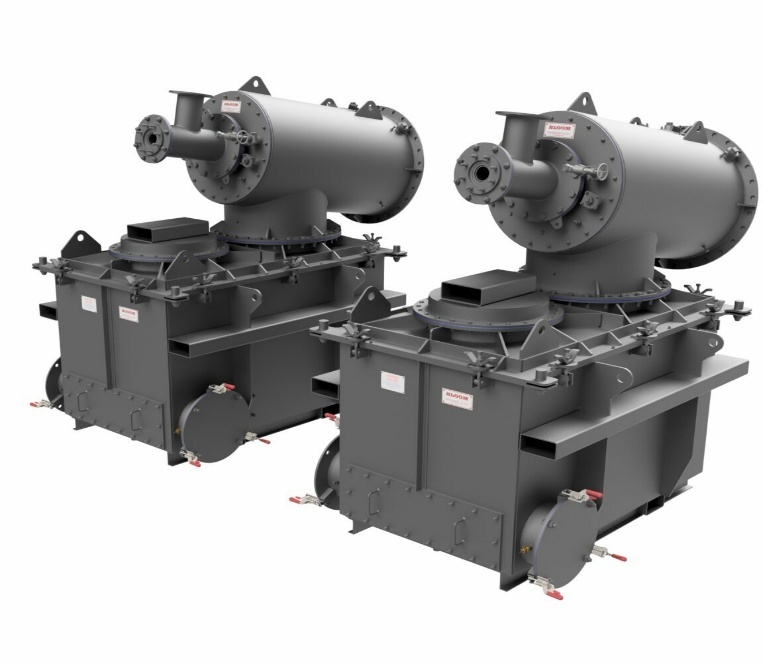
A regenerative combustion system uses a pair of burners, each equipped with a media case filled with dense ceramic material. These burners alternately switch between firing and exhausting modes. During exhaust mode, hot combustion gases pass through the ceramic media, storing heat close to furnace temperature.
When the burner switches to firing mode, cold combustion air flows through the heated ceramic media, rapidly increasing air temperature before combustion. This cyclic operation captures and reuses waste heat from flue gases, resulting in exceptional fuel efficiency for high-temperature industrial processes.
Capabilities
- World-leading low NOx technology
- Reduced carbon dioxide (CO₂) emissions
- Can utilize multiple gaseous and liquid fuels including hydrogen
- Increased production from existing furnaces
- Stable operation from cold start through entire operating range
- Excellent turndown capability
- Custom engineered for specific applications
Features
- Refractory baffle protects burner body, stabilizes and shapes the flame, and supports the gas nozzle
- Capacities from 2.5 to 52.5 MMBtu/hr – HHV (700 kW to 15,000 kW)
- Available in English and Metric designs
- Flame monitoring using UV detection
-
Typical NOx performance in Aluminium melting
applications:
- Series – NOx < 70 ppm @ 3% O₂ (140 Mg/Nm³)
Applications
-
Steel
- Reheat Furnaces
- Tunnel Furnaces
- Batch Annealing
- Continuous Galvanizing Lines (CGL)
- Continuous Annealing Lines (CAL)
- Silicon Lines
- Non-Ox Furnaces
- Steckel Mill Furnaces
- Ladle Preheating and Dry-out
- Forge Furnaces
- Soaking Pits
- Hot-Blast Stoves
- Flare Stack Burners and Ignition
- Edge Heaters
-
Aluminium & Other Non-Ferrous
- Melting Furnaces
- Round Top Furnaces
- Rectangular Furnaces
- Side Well Furnaces
- Tilting Rotary Furnaces
- Holding Furnaces
- Muffle Furnaces
-
Process Heating
- Iron Direct Reduction
- Steam Methane Reforming
- Incineration
- Thermal Oxidizers
- Pelletizing
- Sintering Furnaces
- Air Heating & Drying
- LNG Vaporization